


Your child is finally tall enough to ditch the booster. Or so it seems. But every journey, the shoulder belt saws across their neck, sometimes their cheek, and you hear about it from the back seat all the way to school.
So you search. Dozens of cheap "seat belt adjusters" appear, promising comfort and safety for under a tenner. Are these things actually safe, or just a quick fix with hidden risks?
Retailers sell them as harmless comfort aids. Social media calls them a clever parenting hack. The organizations that actually crash-test child safety equipment tell a very different story, and we're going to walk you through it, using evidence from NHTSA (the US road safety regulator), the Children's Hospital of Philadelphia (CHOP), Safety Belt Safe USA and the UK Department for Transport.
You'll get a clear yes-or-no verdict straight away, a plain-language explanation of the crash physics, and safer alternatives you can use today, several of which cost nothing. There's also a printable checklist to keep in the car.
Before you buy anything, do one thing: check your child's current belt fit against the five-point seat belt fit test further down the page. It may change what you think you need.
The Short Answer: Are Seat Belt Adjusters Safe for Kids?
No. Aftermarket seat belt adjusters are not recommended for children.
No safety standard covers them. Nobody requires them to be crash-tested. And NHTSA has formally stated it has significant concerns about how they affect belt performance. That's the answer you came for.
Here's why it matters. Any device that changes where the lap or shoulder belt sits is a safety modification, not a comfort accessory. It changes how crash forces load your child's abdomen and spine.
Expert Tip: Treat any aftermarket device that changes where the lap or shoulder belt sits as a safety modification, not a comfort accessory, because it can alter how crash forces load the abdomen and spine.
What we'll cover: what these devices are, why no standard applies to them, what NHTSA found when it crash-tested them, what experts recommend instead, and practical fixes for neck discomfort that don't compromise safety.
What Seat Belt Adjusters Are and How They Are Marketed
Defining Aftermarket Belt Positioning Devices
"Seat belt adjuster" is a retail label. The technical name is aftermarket belt positioning device, and it covers three common designs:
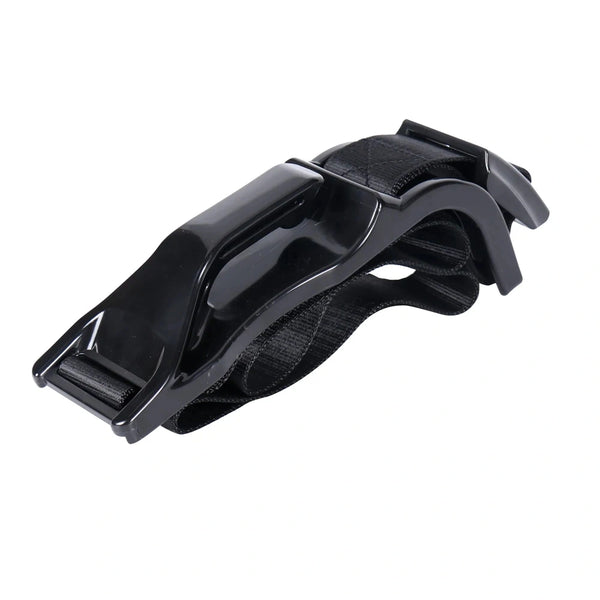
- Connector clips that fasten the shoulder belt to the lap belt, dragging the shoulder belt down and inwards.
- Fabric wraps and straps that pull the belt down or sideways, sometimes anchored to the seat.
- Triangular fabric guides that slide onto both parts of the belt and reposition the shoulder belt towards the center of the chest.
They're marketed to parents of children who have "outgrown" boosters, and to small adults who find the shoulder belt uncomfortable. Listings describe them as comfort or safety accessories, with phrases like "keeps the belt off the neck" or "safe and easy." You'll rarely see a named crash test or safety standard.

Seat Belt Adjuster for Kids & Short Adults, Neck Comfort Clip
- Repositions the strap away from the neck and face
- Snap-on in seconds, no tools or permanent modifications
- Soft, cushioned mesh padding for long drives
- Washable and breathable, unsnaps for easy cleaning
- Free UK & USA delivery
Available in Black, Red, Blue, Grey and Pink
Comfort accessory only — does not replace a legal child car seat or booster seat.
Why Parents Reach for Them
The problem is real. Your child has hit the age or height where the booster feels optional, but their torso is still short. So the shoulder belt crosses their neck or face.
Add the social pressure. At nine or ten, a booster feels babyish. Friends don't use one. Your child pushes back, and you want a solution that respects their growing independence without cutting corners on safety.
The discomfort is genuine. A belt rubbing the neck is irritating on every trip. But the adjuster clip is the wrong answer to a real problem, and the rest of this guide explains why.
The Regulatory Gap: No Federal Safety Standard Applies
Aftermarket Devices Are Not Regulated Like Car Seats
Child car seats and belt-positioning boosters have to pass crash tests before they can be sold. In the US, that's Federal Motor Vehicle Safety Standard 213. In the UK and Europe, it's UN Regulation R44 or R129, shown by an orange label with a capital "E" in a circle.
Aftermarket belt adjusters have nothing equivalent. In a formal interpretation letter, NHTSA stated plainly that it does not have a safety standard that directly applies to belt positioning devices. They don't have to be crash-tested, and no government agency certifies them. The UK is no different: R44 and R129 approve child restraints, not add-on clips for the adult belt.
What This Means for Parents
A product can sit on a major retailer's website, collect hundreds of five-star reviews, and never have been near a crash sled. Reviews tell you whether a clip is comfortable and easy to fit. They tell you nothing about what happens at 30 mph.
If packaging says "safe" or "crash tested," treat that as a claim, not a fact. With no standard to test against, nobody checks that marketing language is true.
Expert Tip: Verify any product claim against an official source such as NHTSA, CHOP, or SafetyBeltSafe USA, since aftermarket belt devices are not covered by a federal safety standard.
In the UK, add the Department for Transport's guidance and RoSPA's childcarseats.org.uk to that list. Ask any seller which test, which standard and which lab. A genuine answer names all three.
The Crash Physics: Why Moving the Belt Is Dangerous
How Seat Belts Are Designed to Work
A lap-and-shoulder belt is engineered to load the strongest parts of the body. The lap belt sits low across the hip bones (the pelvis). The shoulder belt crosses the collarbone and the middle of the chest, over the ribcage.
In a crash, the belt spreads enormous forces across those bones. The bones take the load so the soft organs in the abdomen, and the spine behind them, don't have to.
What Happens When an Adjuster Changes Belt Geometry
Clips that join the shoulder belt to the lap belt, or pull the shoulder belt down, shift the point where the two belts meet towards the middle of the abdomen. That's the core problem.
NHTSA explains that US vehicle standard FMVSS 208 deliberately requires the lap and shoulder belt to intersect off the abdominal area, so crash forces go into the skeleton. A device that moves that intersection to the middle of the abdomen could greatly increase abdominal loading, with serious consequences for internal organs.
NHTSA flagged a second concern too. Realigning the shoulder belt could make the wearer more likely to twist towards the middle of the car in a crash, changing how forces load the spine and ribs.
Picture a load-bearing wall in a house. Move the wall, and the weight shifts onto a part of the structure that was never built to carry it. Belt geometry works the same way.
Myth vs. Fact: "Soft Adjusters Are Safe Because They Are Just Fabric"
| Myth | Fact |
|---|---|
| "If the adjuster is made of soft fabric or padding, it cannot cause injury." | The material matters far less than the geometry. Even a soft device that pulls the belt out of its designed position can redirect crash forces onto the abdomen or change shoulder belt alignment. |
| "A clip that keeps the belt off the neck is safer than letting it rub." | Neck rubbing is a comfort problem, not a crash-safety problem. Moving the belt with a clip creates a crash-safety problem. A comfort fix should never introduce a new injury risk. |
| "If it has good reviews on Amazon, it must be safe." | Reviews reflect comfort and convenience, not crash performance. No standard requires these devices to be crash-tested. |
| "Adjusters are just like booster seats; they position the belt." | Boosters raise the child so the adult belt fits correctly at the car's designed anchor points. Adjusters alter the belt path itself, which is fundamentally different and not crash-tested. |
What NHTSA Crash Testing Actually Found
The Testing Results in Plain Language
NHTSA has crash-tested these devices more than once. In a 1994 study, it tested three belt positioners on child and small-adult crash dummies, with and without the devices. In many tests with the 3-year-old dummy, the positioners reduced belt performance and produced excessive head injury readings. With the 6-year-old dummy, one device pushed chest acceleration past the child restraint limit. In every case, the vehicle belt restrained the dummy less well.
A later evaluation, reported to the US Congress in 2002, reached the same conclusion. Its words were blunt: all of the devices evaluated produced some degradation in the performance of the lap and shoulder belt system.
What does "degradation" mean for you? The belt didn't do its job as well with the device attached. The adjuster made the belt worse at protecting the person wearing it. Not better.
The Key Takeaway from the Testing
Belt positioning devices exist for comfort. SafetyBeltSafe USA is explicit that their purpose is to improve comfort, not to prevent neck injuries. A belt touching the neck in normal driving isn't what injures children in crashes.
The devices didn't improve safety. Some made the belt perform worse.
That's not a risk worth taking with a child.
Expert Tip: Remember that the purpose of a belt-positioning device is comfort, not added safety; in crash tests these devices generally did not reduce neck force.
What the Experts Recommend Instead
Belt-Positioning Boosters: The Evidence-Backed Solution
CHOP, SafetyBeltSafe USA, the American Academy of Pediatrics and the UK Department for Transport agree: children should use a belt-positioning booster until the vehicle's own lap and shoulder belts fit them correctly.
The evidence is strong. CHOP's research, published in Pediatrics in 2009, studied more than 7,000 children aged 4 to 8 in real crashes. Children in belt-positioning boosters were 45% less likely to be injured than children using seat belts alone. NHTSA cites the same finding in its own safety countermeasures guidance.
The mechanism is simple. A booster lifts your child so the lap belt sits low across the hips and the shoulder belt crosses the middle of the chest. It works with the car's belt system instead of altering it.
UK law backs this up. Children must use the correct child restraint until they're 135 cm tall or 12 years old, whichever comes first, and the DfT says it's safer to keep using a booster until about 150 cm.
Why a Booster Is Different from an Adjuster
A booster changes your child's position relative to the belt. An adjuster changes the belt's position relative to your child's body. The first is crash-tested and regulated. The second is neither.
Booster Seat vs Neck Comfort Clip: Which One Do You Need?
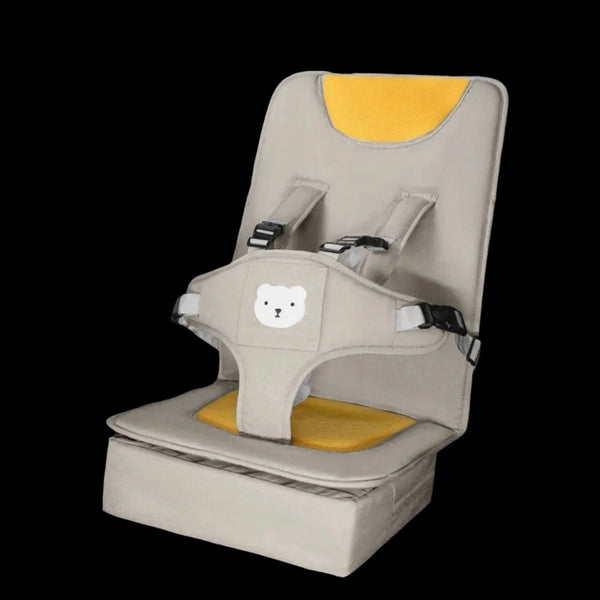
Portable Baby Booster Seat
Raises a child up so the seat belt sits correctly across the body.
Best for
- Younger kids who still need extra height
- Switching the seat between different cars
- Correcting the belt's position, not just its comfort
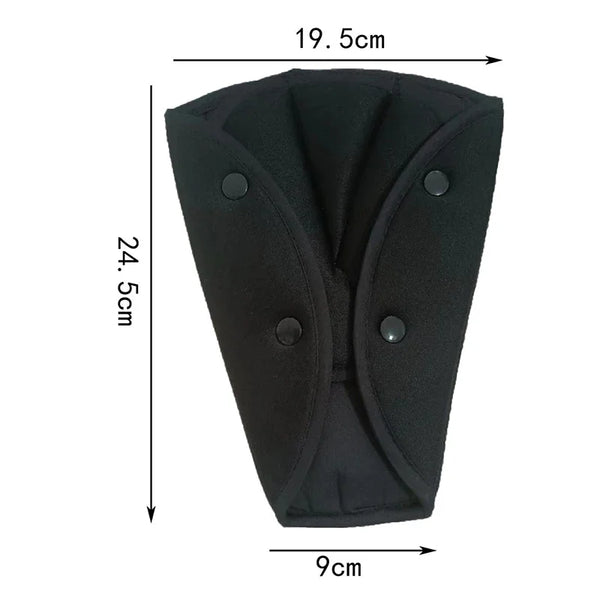
Seat Belt Adjuster, Neck Comfort Clip
Clips onto the belt to stop the strap rubbing the neck.
Best for
- Older kids who've outgrown a booster seat
- Shorter adults bothered by strap position
- Quick snap-on comfort with no bulky seat
Your child may push back. Treat the booster the way you treat a cycle helmet: a non-negotiable safety boundary, not a debate. Older children respond better to a straight explanation ("the belt is built for grown-up bones, and the booster makes it fit yours") than to "because I said so."
Expert Tip: Keep children in a belt-positioning booster until the vehicle lap and shoulder belts fit correctly, typically around 4 feet 9 inches tall and between ages 8 and 12, as recommended by the American Academy of Pediatrics.
Expert Tip: Do not rely on a seat belt adjuster as a substitute for a booster for a child who still needs one; the booster raises the child so the belt fits properly, which an adjuster cannot safely replicate.
Myth vs. Fact: "My Child Is Too Old for a Booster"
| Myth | Fact |
|---|---|
| "My child is 9, so they're too old for a booster." | Age alone doesn't decide readiness. The belt fit test does. Most children don't fit the adult belt properly until about 145 cm (4 ft 9 in), typically between 8 and 12. In the UK, they must use a child restraint until 135 cm or 12 years old anyway. |
| "If my child's feet touch the floor, they don't need a booster." | Where the feet land doesn't decide belt fit. The lap belt must sit low across the hips and the shoulder belt across the chest. That's what matters. |
| "Boosters are only for little kids." | High-back boosters approved under R129 typically fit children up to 150 cm, and older R44 Group 2/3 boosters up to 36 kg. They're a safety tool for school-age children, not a baby item. |
When a Child Can Safely Use the Adult Belt Alone
The Seat Belt Fit Test
Do this in the car your child rides in most, with no booster, belt buckled.
Step-by-Step: The Five-Point Seat Belt Fit Test
- Back against the vehicle seat: Can your child sit with their back flat against the seat back, knees bending at the edge of the seat, comfortably? If not, they still need a booster.
- Knees at the edge: Their knees should bend at the front edge of the seat. If they slouch forward to get their knees over the edge, they still need a booster.
- Lap belt low across the hips: The lap belt should sit flat and low across the upper thighs and hip bones, not the soft belly. If it rides up onto the abdomen, they still need a booster.
- Shoulder belt across the chest: The shoulder belt should cross the middle of the chest and shoulder, not the neck or face. If it touches the neck or crosses the face, they still need a booster, or a comfort fix that doesn't alter belt geometry.
- Child can hold the position: They should sit upright with the belt correctly placed for the entire journey. If they slump or lean, they still need a booster.
Expert Tip: Perform the simple seat belt fit test before moving a child out of a booster: the lap belt should sit low across the hips, and the shoulder belt should cross the chest, not the neck or face.
The Typical Milestone: 4 Feet 9 Inches, Ages 8 to 12
The American Academy of Pediatrics and CHOP recommend a booster until a child is about 4 ft 9 in (roughly 145 cm) tall, which usually happens between 8 and 12. In the UK, the legal minimum is 135 cm or 12 years old, and the DfT recommends continuing to about 150 cm.
Treat those numbers as guidelines. The fit test is the real standard, because children grow at different rates and every car's belt geometry is different.
Passing in your car doesn't mean passing in a grandparent's car, a hire car or a different seat. Re-test in every vehicle your child rides in regularly.

Safer Alternatives for Neck and Shoulder Discomfort
If your child's shoulder belt rubs their neck, the fix isn't a clip you found on Amazon. It's a booster seat, a movable anchor, or a fabric sleeve, and the difference matters in a crash.
Option 1: Check for a Movable Shoulder Belt Anchor
Many cars have a height-adjustable shoulder belt anchor on the B-pillar, the post between the front and rear doors. Slide it down and the shoulder belt crosses lower on the body.
Check your owner's manual for where it is and how it adjusts. In most cars, adjustable anchors are fitted to the front seats only, so a child in the front passenger seat benefits most. It's the first and best fix because it changes belt geometry at the anchor, exactly as the car maker designed and tested.
Expert Tip: If a child complains the shoulder belt rubs the neck, first check the vehicle owner's manual for a movable shoulder belt anchor and adjust it before buying anything.
Product Recommendation: Your vehicle's own movable shoulder belt anchor. Check the owner's manual for availability and adjustment instructions. It costs nothing.
Option 2: Fabric or Lambswool Shoulder Belt Sleeve
A sleeve wraps around the shoulder belt itself. Unlike a clip or positioning device, it doesn't change where the belt sits. It just softens the edge of the webbing where it touches the neck.
Here's the line that matters. A sleeve that wraps the belt without moving it is a comfort aid. A device that pulls, clips or redirects the belt is a safety modification.
One UK caveat: the Department for Transport warns against improving belt comfort with padding or cushions. Choose a thin sleeve, not a thick pad, and make sure the belt still lies flat against the chest and retracts freely. If your car maker offers an approved comfort accessory, use that first.
Expert Tip: Use a fabric or lambswool sleeve wrapped around the shoulder belt, or tuck the belt under the shirt collar, to reduce neck irritation without changing belt position.
Product Recommendation: A thin fabric or lambswool shoulder belt sleeve that wraps around the belt without repositioning it. Avoid anything that clips to the lap belt or anchors to the seat.
Option 3: The Shirt Collar Technique
Free, and it works. Tuck the shoulder belt under your child's shirt collar so a layer of fabric sits between the belt and their neck. The belt stays exactly where it should be; only the skin contact changes.
It works best with polo shirts, school shirts or tops with a structured neckline. A thin T-shirt won't do much.
Option 4: A Small Soft Towel
SafetyBeltSafe USA suggests keeping a small, soft towel in the car that passengers can place between the belt and the neck. Keep it small and flat.
Don't fold it thickly or wedge it so it lifts the belt off the chest. It's a thin surface layer against the skin, not a positioning device.
Option 5: RideSafer Travel Vest or Similar Regulated Alternative
The RideSafer travel vest is worn by the child and routes the car's belt through guides at the hips and shoulder. In the US, it's certified to FMVSS 213 as a child restraint. That's the key difference from an aftermarket clip: it's designed and tested as a restraint, not sold as an accessory for an existing belt.
The UK problem: current RideSafer models are not certified under R44 or R129, and its US distributor confirms the current vest isn't certified for European use. UK law requires residents to use an R44- or R129-approved child restraint, so a RideSafer isn't a legal everyday option for UK families.
The UK equivalent is an R129-approved compact or folding booster. Several fold small enough for a school bag or carry-on, which covers the carpool, taxi and holiday situations where a full booster is impractical. Use it within the manufacturer's height and weight limits.
Product Recommendation: For UK families, an R129-approved compact or folding travel booster for older children who resist a traditional booster. Check the orange approval label shows "R129" and the height range covers your child. RideSafer travel vests are certified in the US only.
Seat Belt Adjuster Safety Comparison: Which Option Is Right for Your Child?
Side-by-Side Comparison of the Main Options
Use the table as a quick reference to compare how each option works, whether it's regulated or crash-tested, the safety concerns, and who it suits.
| Option | How it works | Regulated or crash-tested | Safety concerns | Best for |
|---|---|---|---|---|
| Aftermarket seat belt adjuster clip | Connects the shoulder belt to the lap belt, or reroutes the shoulder belt to change where it crosses the body | No. No safety standard applies in the US or UK; not crash-tested as a requirement | Can move the lap-shoulder belt intersection towards the abdomen, increasing abdominal loading; may increase upper-body twisting; NHTSA found all tested devices degraded belt performance | Not recommended for children |
| Belt-positioning booster seat (high-back or backless) | Raises the child so the car's lap and shoulder belts fit correctly at the designed anchor points | Yes. R44 or R129 in the UK (FMVSS 213 in the US); crash-tested as a child restraint | Minimal when used within height and weight limits; main risk is moving out of the booster too early | Children who have outgrown a harnessed seat but don't pass the fit test (typically up to 150 cm on R129 models, or 36 kg on R44 Group 2/3) |
| Vehicle movable shoulder belt anchor | Adjusts the height of the shoulder belt anchor on the B-pillar, changing where the belt crosses the body | Yes. Part of the car's original, type-approved belt system | None when used as the owner's manual directs | Children and adults of any size whose shoulder belt crosses the neck or face; check the owner's manual first |
| Fabric or lambswool shoulder belt sleeve | Wraps around the shoulder belt to soften the surface without changing belt position | Not regulated, but doesn't alter belt geometry | Minimal if thin; must not add slack or bulk or stop the belt retracting | Anyone with neck or shoulder irritation from the belt surface, including children who have passed the fit test |
How to Use This Table
- Run the fit test. If your child fails, use a booster. Stop there.
- If they pass but the belt rubs, adjust the movable shoulder anchor, if your car has one. Free.
- If the belt still irritates the neck, add a thin sleeve or use the shirt collar technique.
- Avoid aftermarket adjuster clips entirely.
The table is a quick reference. It doesn't replace the full guidance above or doing the fit test in your actual car.
Narrow Conditions Where a Device Might Be Acceptable for Teens or Adults
The SafetyBeltSafe USA Guidance for Older Users
SafetyBeltSafe USA recommends against belt positioning devices for children. In its guidance on shoulder belt positioning devices, it acknowledges narrow conditions where a device might be acceptable for a teenager or adult:
- The device is made only of fabric or webbing, with no rigid plastic or metal clips.
- It connects only to the shoulder belt, not to the lap belt.
- It adds minimal slack and doesn't pull the belt far from its natural path.
- It's used to stop the teen or adult from putting the shoulder belt under their arm or behind their back, which is far more dangerous than a fabric positioning aid.
Expert Tip: If a teen or adult insists on a positioning device to stop them from putting the belt under the arm or behind the back, choose one made only of fabric or webbing, connected only to the shoulder belt, with minimal slack added.
Think of it as a hierarchy of risk. A belt under the arm or behind the back is extremely dangerous: it removes all upper-body restraint. If a fabric-only, shoulder-belt-only device stops a teen or adult doing that, it's the lesser risk. That logic stops at adults and teens. It doesn't extend to children, who belong in a booster.
Why This Does Not Apply to Children
Those conditions are for teens and adults who already pass the seat belt fit test and whose only issue is shoulder belt comfort, or a habit of moving the belt out of place. A child who fails the fit test needs a booster, not a positioning device.
No expert source we reviewed recommends aftermarket belt positioning devices for children under any conditions.
Printable Parent Safety Checklist
Screenshot it, print it, or copy it into your phone notes. Keep a copy in the glovebox and share it with anyone who drives your child.
Seat Belt Safety Checklist for Your Child
The Belt Fit Test: Does Your Child Pass All Five?
- ☐ Back sits flat against the vehicle seat back
- ☐ Knees bend at the front edge of the vehicle seat
- ☐ Lap belt sits low and flat across the upper thighs and hips (not the belly)
- ☐ Shoulder belt crosses the center of the chest and shoulder (not the neck or face)
- ☐ Child holds this upright position for the whole journey without slouching
Any box unchecked? Your child still needs a belt-positioning booster.
Booster Milestones to Remember
- UK law: child restraint until 135 cm or 12 years old; safer until about 150 cm
- Most children need a booster until about 145 cm (4 ft 9 in)
- Typical age range for moving out of a booster: 8 to 12
- Re-test the fit in every vehicle your child rides in regularly
- Boosters reduce injury risk for ages 4 to 8 by 45% versus seat belts alone (CHOP)
Safer Alternatives to Aftermarket Adjusters
- Check the owner's manual for a movable shoulder belt anchor; adjust it first
- Try a thin fabric or lambswool sleeve that wraps the belt without moving it
- Tuck the belt under the shirt collar for a no-cost fix
- Use a small soft towel between belt and neck (don't fold it thickly)
- For resistant older children in the UK, an R129-approved compact travel booster
Red Flags: Do Not Use
- Any device that connects the shoulder belt to the lap belt
- Any device that pulls the lap belt upwards towards the abdomen
- Any child product without R44 or R129 approval
- Any device sold as a "safety" product without naming the test, standard and lab
Expert Tip: Never use a device that connects to the lap belt or pulls it upward, because this can move the belt onto the abdomen and increase the risk of internal injury.
Frequently Asked Questions
Can I use a seat belt adjuster if my child has already passed the belt fit test?
If your child passes and the only issue is neck irritation, use a movable anchor, a thin fabric sleeve or the shirt collar technique, not a clip that repositions the belt. Passing the fit test means the belt is already in the right place. Don't move it.
Are seat belt adjusters illegal?
Generally, no. They're legal to sell and buy in the UK and US. But they aren't regulated, aren't required to be crash-tested, and aren't recommended for children by NHTSA, CHOP or SafetyBeltSafe USA. Legal to buy doesn't mean safe to use. In the UK, a child who still needs a restraint by law must use an approved booster, and an adjuster doesn't count as one.
What if my child refuses to sit in a booster?
Very common. Frame the booster as a safety tool, not a baby item, and hold the line the way you would with a cycle helmet. A backless booster is less conspicuous for older children, as long as they meet its minimum height and weight: new backless models are only approved from 125 cm and 22 kg. A compact R129 travel booster also helps for carpools. Never substitute an adjuster clip for a booster your child still needs.
Do seat belt adjusters work for adults who are short-statured?
Start with the movable shoulder belt anchor and a thin fabric sleeve. If a positioning device is still needed, SafetyBeltSafe USA's conditions apply: fabric only, shoulder belt only, minimal slack, and used to stop the belt going under the arm or behind the back.
My child's shoulder belt crosses their face, not just their neck. What should I do?
If the belt crosses the face, your child almost certainly fails the fit test and needs a booster. A belt on the face is a clear sign they're too short for the adult belt system. Don't use an adjuster. Use a booster.
Conclusion
The Bottom Line for Parents
Aftermarket seat belt adjusters are not a safe solution for children. They're unregulated, NHTSA found they degraded belt performance in crash testing, and they can redirect crash forces onto the abdomen.
Your child's discomfort is real and worth fixing, with the right tools. A booster if they fail the fit test. A movable anchor or a thin sleeve if they pass.
NHTSA, CHOP, SafetyBeltSafe USA and the UK Department for Transport all point the same way. The safest path works with your car's belt system, not against it.
Final Call to Action
Do the five-point fit test with your child today, in the car they ride in most. Then share the checklist with grandparents, carpool drivers and anyone else who drives them, so everyone follows the same rules. For the law on children in taxis and minibuses, see our UK taxi, coach and minibus car seat guide, and for why extenders don't belong on boosters either, read are seat belt extenders safe for boosters.
Disclaimer: Our article is educational and based on publicly available guidance from NHTSA, CHOP, SafetyBeltSafe USA, the UK Department for Transport and GOV.UK. It is not a substitute for advice from a trained child passenger safety adviser. For a personal car seat or belt fit check, book a free check through Good Egg Safety or your local council road safety team. Spotted an error? Tell us

About the author
Piotr Nartowski
Founder, Seat Belts Extender UK
Piotr has hands-on experience with seat belt extender fitment, vehicle compatibility and ECE R16 certification information. He helps customers choose correctly fitting products and understand where seat belt extenders should and should not be used.


