


You're booking a flight, and the airline tells you a lap infant travels free, or for £25. Tempting. Then a nagging thought: is that actually safe?
Parents get contradictory answers. Forums say it's fine because millions do it. Safety agencies say something rather different, and most parents never see what they say. Meanwhile turbulence is the most common cause of in-flight injuries, and no adult's arms hold a wriggling toddler through sudden clear-air turbulence.
You can legally hold your under-2 on your lap, but the FAA and NTSB both say that's not the safest choice, and here's exactly what to do instead.
Our guide covers the age limits, the official positions, the UK and US rules (which differ in one important way), the restraint options that are actually approved, a UK airline policy comparison, and a step-by-step plan from booking to landing.
Bookmark it before you book, and send it to whoever is travelling with you.
Lap Child Rules and Age Limits
The Baseline Policy: Under 2 on an Adult's Lap
Children under 2 may travel on an adult's lap on almost every airline, in the UK, Europe and the US alike. Under-2s usually fly free on US domestic routes and on Jet2; other UK carriers charge a flat fee or a percentage of the adult fare.
Legal baseline, not a safety recommendation. Both the FAA and the NTSB discourage lap-holding.
There's one significant difference between the UK and the US, and it catches people out.
- UK and European carriers: a lap infant must be secured with a supplementary loop belt (also called an infant belt or extension belt), which threads onto the adult's own seat belt. Cabin crew hand it to you after boarding, and it must be used for taxi, take-off, landing and turbulence.
- US carriers: loop belts are not approved by the FAA, and US airlines don't provide them. A lap infant travels held, with no device.
At age 2, the lap-child option ends. Your child needs their own seat.
Expert Tip: Buy a seat for your child whenever possible. The FAA and NTSB strongly recommend a child restraint system over lap-holding, which is the single most effective safety upgrade.
What Changes at Age 2
On the day your child turns 2, lap travel ends on most airlines.
Watch the return leg. Ryanair, for example, applies adult fares, fees and taxes to an infant who turns 2 before the return journey. British Airways and others handle it differently, with some carriers charging the infant fare throughout but requiring a seat from the birthday onwards. The rule varies by carrier, and getting it wrong at the gate is expensive.
Expert Tip: Verify your specific airline's lap-child and restraint policies before booking, as rules and fees differ by carrier and route.
Airline Variations and International Flights
Lap infants fly free on US domestic routes and with Jet2. Ryanair and easyJet charge around £25 per flight. British Airways charges 10% of the adult fare plus taxes, which on a long-haul route is a real sum. Minimum ages vary too, commonly 7 to 14 days old.
Bassinets (carrycots or sky cots) are fitted only at bulkhead rows on long-haul aircraft. British Airways offers them from birth to 24 months up to 12.5kg, pre-booked through Manage My Booking, and usable only when the seat belt signs are off. Short-haul carriers such as easyJet, Ryanair and Jet2 don't have them at all.
Expert Tip: For infants under 2 who will be held, request a bassinet where offered and confirm the airline's weight limit (often around 20 lbs / 9 kg) before booking.
Weight limits differ by airline and aircraft: BA's limit is 12.5kg, while many carriers set theirs nearer 9kg (about 20 lbs). Check yours rather than assuming.
Why Lap-Holding Is Discouraged: the FAA and NTSB Position
The Official Safety Alert
NTSB Safety Alert SA-015, Child Passenger Safety on Aircraft, states the position plainly: children under 2 may be held on a lap, but an adult may not be able to hold a child securely during turbulence or an emergency. The alert notes that preventable deaths and injuries have occurred among unrestrained children under 2.
Read it yourself at ntsb.gov. It's one page.
Turbulence: the Most Common In-Flight Injury Scenario
NTSB safety recommendation A-21-041, issued in 2021, notes that turbulence-related accidents are the most common in-flight injury scenario in commercial aviation.
Not a rare catastrophe. A routine event, several times a year, usually without warning.
Why an Adult's Arms Aren't Enough
Sudden clear-air turbulence can push loads well beyond what any grip can hold. An unrestrained child can leave your arms entirely.
A lap-held child also isn't protected by the aircraft seat belt. In a hard drop they can strike the seat in front, the armrest, the ceiling, or another passenger.
A loop belt on a UK carrier helps, and it's a legal requirement here, but it isn't equivalent to a proper restraint. It keeps an infant attached to the adult. A certified child restraint in the child's own seat is a different level of protection.
Expert Tip: Always buckle the child into their restraint during taxi, takeoff, landing, and whenever the fasten-seatbelt sign is on, even if they are sleeping.

Child Restraint Options: Car Seat and CARES Harness
Approved Car Seats
A car seat used on a US-registered aircraft must carry a label stating: "This restraint is certified for use in motor vehicles and aircraft." UK and European carriers set their own requirements, and they're stricter on dimensions than on labelling.
British Airways requires a car seat no wider than 43cm, facing the same direction as the aircraft seat it's secured to, with the child within the manufacturer's age and weight range. Ryanair requires a forward-facing seat no wider than 43cm with an approved five-point harness. easyJet publishes its own approved list. Most airlines require the restraint to go in a window seat so it can't block anyone's exit path.
One installation detail from the European guidance is worth knowing: a forward-facing seat with a rigid back should be fastened while the aircraft seat back is reclined, then the seat back returned upright. It pulls the installation noticeably tighter.
Expert Tip: Check for the FAA approval label on any car seat before flying; the seat must state it is certified for use in motor vehicles and aircraft.
Expert Tip: Practice installing the car seat at home so you are not struggling in a cramped cabin.
If you're taking the car seat to use at the other end too, check it will work in your hire car. Our guides to ISOFIX versus seat belt installation and UK child car seat law cover what to check before you travel.
CARES Harness (Child Aviation Restraint System)
CARES is the only harness-type child restraint the FAA has certified as giving an equivalent level of safety to a car seat. It's also certified by the UK CAA and accepted by many airlines, British Airways among them.
It's a webbing harness that loops over the seat back and takes the aircraft lap belt through two loops at the shoulders. It weighs about 450g and packs into a small bag, which is the point.
Three things to know:
- Your child needs their own purchased seat. CARES can't be used with a lap infant.
- It's approved for children at least 1 year old, 22 to 44 lbs (10 to 20kg), and under 40 inches (about 102cm) tall.
- It's for aircraft only, never for cars. Check the label reads "FAA Approved in Accordance with 14 CFR 21.8(d), Approved for Aircraft Use Only" or the older 21.305(d) wording. Counterfeits are sold online, so buy from the manufacturer or an authorized seller.
Expert Tip: Use the CARES harness only for children who are at least 1 year old, weigh 22 to 44 pounds, and are under 40 inches tall, and only in the child's own purchased seat.
No restraint removes all risk, and the limits above come from AmSafe and the FAA rather than from us. Confirm your airline accepts CARES before you fly; acceptance is widespread but not universal.
Car Seat vs CARES Harness at a Glance
| Feature | Approved car seat | CARES harness |
|---|---|---|
| Age, weight, height limits | Varies by model; must carry the aircraft approval label and meet the airline's width limit (often 43cm) | At least 1 year, 22 to 44 lbs, under 40 inches |
| Installation | Secured to a window seat with the aircraft lap belt | Loops over the seat back; the child uses the aircraft lap belt through the harness loops |
| Best for | Infants and toddlers of all sizes, including babies too small for CARES, and anyone needing the seat at the destination | Toddlers within the limits who have their own seat |
| Portability | Bulky; carried or wheeled through the airport | About 450g, folds into a carry bag |
| Approval | Label must state certification for motor vehicles and aircraft | The only harness-type restraint the FAA has certified as equivalent to a car seat; also CAA certified; aircraft use only |
Aircraft Seat Belt Extenders
Some car seat installations need the aircraft belt to reach further than the standard belt allows. Ask a crew member after boarding, and they'll provide the airline's own extender and show you how to use it.
Two cautions, both from the FAA's advisory circular on child restraints:
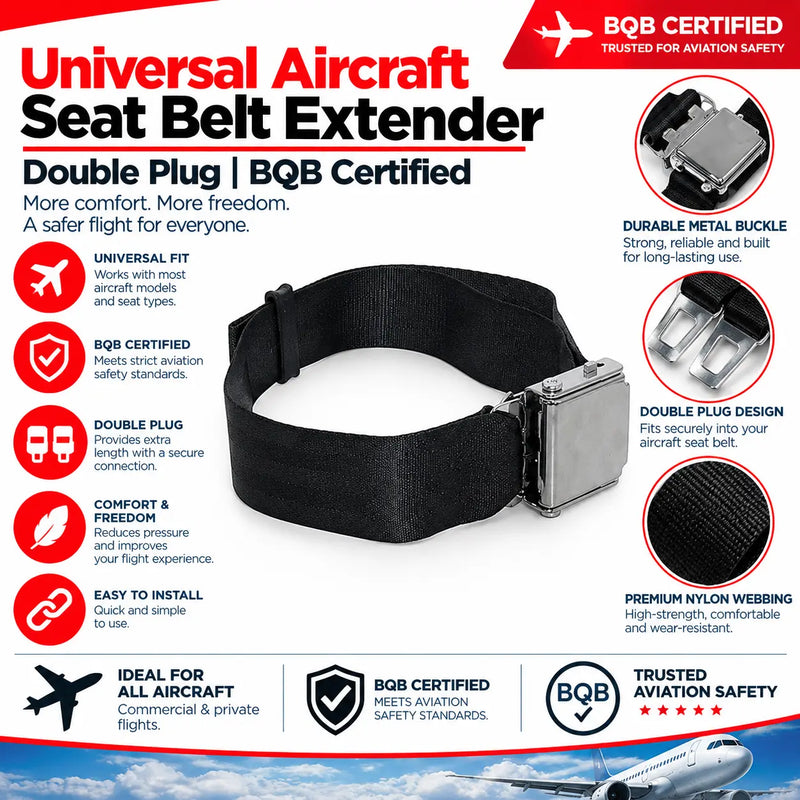
Universal Aircraft Seat Belt Extender | Double Plug | BQB Certified
- Universal fit for most major airlines (Type A)
- Dual-plug lock stays secure through turbulence
- BQB certified by independent safety testing
- Steel and nylon build, buckle tested to ~1.6 tons
- 23 cm of extra length, adjustable strap
- Carry-on ready, only 210 g
For aircraft use only. Southwest Airlines needs the Type B extender instead.
- Never combine an extender with a child restraint in a seat fitted with an inflatable seat belt. The FAA warns that doing so can cause death or serious injury. Inflatable belts appear in some premium cabins, and the belt is marked.
- Use the airline's extender, not your own, for a child restraint. Crew are responsible for confirming the restraint is properly secured, and an unfamiliar device complicates that.
Airline Policy Comparison Table
UK and European carriers, with policies as published in September 2026. The outline for this piece listed US carriers, but our readers mostly fly from UK airports, and five of the six US rows were unverified.
| Airline | Lap infant policy | Bassinet | Restraint notes |
|---|---|---|---|
| British Airways | Under 2 on the lap at 10% of the adult fare plus taxes; minimum age 7 days; crew provide an extension belt for taxi, take-off, landing and turbulence | Long-haul, bulkhead only; birth to 24 months, up to 12.5kg; pre-book | Own car seat allowed with a purchased seat, max 43cm wide, facing the direction of the aircraft seat; CARES accepted |
| easyJet | Under 2 on the lap, around £25 per flight; one infant per adult; minimum age 14 days | Not available | Car seat or CARES permitted in a separately booked seat; check the approved list. Lap infants cannot use a car seat in the cabin |
| Ryanair | 8 days to 23 months on the lap, £25 per one-way flight; infant seat belt provided by crew; adult fare applies if the child turns 2 before the return | Not available | Car seat only with a purchased seat: forward-facing, max 43cm wide, aircraft-approved, five-point harness; call before booking |
| Jet2 | Under 2 travel free on the lap; minimum age 14 days | Not available | Approved car seats permitted when the child has their own paid seat |
| TUI, Wizz Air and other carriers | Fees and minimum ages vary; check at booking | Varies; short-haul fleets generally have none | Restraint rules and width limits vary; confirm with the airline |
| US carriers (United, American, Delta, Southwest and others) | Under 2 on the lap, usually free on domestic routes; no loop belt, because the FAA does not approve them | Long-haul aircraft only; limits vary | Approved car seat or CARES in a purchased seat; the FAA-approval label is required |
Policies checked September 2026 against the airlines' published family travel pages. Fees, minimum ages and bassinet limits change; confirm before booking.
Step-by-Step Guide to Flying With a Restraint
Before Booking
Decide between lap-holding and buying a seat. Weigh your child's age and size, the length of the flight, and what a second seat actually costs on that route. A £25 short-haul infant fee and a 10% long-haul fare are different decisions.
Then check the airline's lap-child and restraint rules, including car seat width limits.
Expert Tip: Buy a seat for your child whenever possible: the FAA and NTSB strongly recommend a child restraint system over lap-holding.
If you're buying a seat, choose the restraint next: an approved car seat for babies and for anyone outside the CARES limits, or the CARES harness for a toddler within them who doesn't need a car seat at the destination.
At Booking
Buying a seat? Select a window seat for the restraint, and avoid exit rows and the rows immediately in front of or behind them, where restraints aren't permitted.
Lap-holding? Add the infant to the booking, and request a bassinet position at the bulkhead if the aircraft has them.
Expert Tip: For infants under 2 who will be held, request a bassinet where offered and confirm the airline's weight limit before booking.
Preparing at Home
Practise. Fit the car seat or the CARES harness on a dining chair until you can do it without reading the instructions. Cabin aisles are narrow, boarding is fast, and people are watching.
Measure the car seat's width too, and compare it with the airline's limit before you leave the house.
Expert Tip: Practice installing the car seat or fitting the CARES harness at home so you are not struggling in a cramped cabin.
Expert Tip: Bring printed or saved documentation of the restraint's FAA approval in case a crew member questions it.

At the Airport and Boarding
Arrive early. Gate-check the pushchair. Board when family boarding is called, so you have time to fit the restraint before the aisle fills.
Install in the window seat. If the belt won't reach around the car seat, ask the crew for the airline's extender.
Expert Tip: Place the child's restraint in a window seat so it does not block an aisle or another passenger's exit path.
In Flight
Buckle the child in for taxi, take-off, landing and every time the seat belt sign comes on. Keep the harness snug: no slack you can pinch at the collarbone.
On long-haul, plan for the awkward middle hours. Familiar comforters, snacks, and a change of scene while the sign is off.
Expert Tip: Always buckle the child into their restraint during taxi, takeoff, landing, and whenever the fasten-seatbelt sign is on, even if they are sleeping.
Expert Tip: Schedule flights around your toddler's nap or bedtime to reduce the wriggling that makes lap-holding and restraint use harder.

Type B Plane Seat Belt Extender | FAA Compliant | Southwest
- Fits most Southwest aircraft (Type B buckle)
- FAA compliant manufacture for aircraft use
- Adjustable 18 to 61 cm for a personal fit
- Discreet, no need to ask cabin crew
- Metal buckle and nylon strap built for repeat flights
- 1-year warranty against manufacturing defects
Not compatible with Southwest Boeing 737-800 or 737 MAX 8 (those need Type E). For aircraft use only.
Turbulence and In-Flight Safety Practices
Why Turbulence Matters for Unrestrained Children
Turbulence-related accidents are the most common in-flight injury scenario, per NTSB recommendation A-21-041. Clear-air turbulence gives no visual warning, doesn't show on weather radar, and arrives in seconds. Nobody gets time to prepare.
Concrete Habits for Every Flight
- Keep the child buckled whenever they're seated, even when the sign is off during cruise.
- Leave the restraint installed for the whole flight rather than removing it to free up space.
- Do nappy changes and stretches early in cruise, not late, when turbulence risk often rises.
Expert Tip: Always buckle the child into their restraint during taxi, takeoff, landing, and whenever the fasten-seatbelt sign is on, even if they are sleeping.
Managing Long-Haul Fatigue and Comfort
Lap-holding stops being viable long before an eight-hour flight ends. Toddlers get hot, heavy and restless, and so do you.
A bassinet gives an infant somewhere to sleep while the sign is off, on airlines that fit them. Note the practicalities: bassinets are allocated at the bulkhead, they must be pre-booked, they aren't guaranteed, and the baby comes out every time the sign comes on.
Expert Tip: Schedule flights around your toddler's nap or bedtime to reduce the wriggling that makes lap-holding and restraint use harder.
Lap Child vs Own Seat Decision Flowchart
How to Use the Flowchart
Start with your child's age, then weight and height. Tap each step.
Step 1: How old is your child?
Under 2: Lap-holding is legal but not the safest choice. If the budget allows, buy a seat and use a restraint. If not, lap-hold with the crew's loop belt on a UK or European carrier, and request a bassinet for an infant within the weight limit.
2 or older: Your child must have their own seat. Go to Step 2.
Step 2: You've bought a seat. Is your child at least 1 year, 22 to 44 lbs, and under 40 inches?
Yes: The CARES harness is a lightweight option, if your airline accepts it.
No: Use an approved car seat, rear-facing or forward-facing as appropriate for your child.
Step 3: Is your child under 1, or under 22 lbs?
CARES isn't approved for them. Use an approved car seat carrying the required label, within your airline's width limit.

Turbulence Incidents: What the Record Shows
Why Real Incidents Make the Risk Concrete
Statistics slide off. Incidents stick.
What the record consistently shows is the pattern rather than any single case. In turbulence injury investigations, the people hurt are overwhelmingly those who were not wearing a seat belt at the moment it hit: passengers moving about the cabin, passengers seated with the belt unfastened, and cabin crew working. Passengers who were buckled generally walk off the aircraft.
The NTSB's own conclusion, in recommendation A-21-041, is that turbulence-related accidents are the most common in-flight injury scenario. The lesson transfers directly to a lap-held toddler: the protection comes from being restrained when it happens, and turbulence doesn't announce itself.
Frequently Asked Questions
Is it legal to fly with a child on my lap?
Yes, for children under 2 on almost every airline. UK and European carriers require a supplementary loop belt provided by the crew; US carriers don't use them. International fares may charge a percentage of the adult fare. Legal doesn't mean safest.
What are the age and weight limits for a lap child?
Under 2 years old, on virtually every carrier. There's no weight limit for lap-holding itself, but bassinets have one: around 9kg (20 lbs) on many airlines, 12.5kg on British Airways.
Is the CARES harness FAA-approved?
Yes, and it's certified by the UK CAA too. CARES is the only harness-type child restraint the FAA has certified as equivalent to a car seat. It's approved for children at least 1 year old, 22 to 44 lbs, and under 40 inches tall, in their own purchased seat, and for aircraft use only.
Do I have to buy a seat for my toddler?
Under 2, no, though the FAA and NTSB strongly recommend it. At 2 and older, a purchased seat is required.
Can I use a car seat on a plane?
Yes, if it carries the label "This restraint is certified for use in motor vehicles and aircraft" and meets your airline's requirements, commonly a width limit of about 43cm. It goes in a window seat, and your child needs their own ticket.
What about international flights?
Policies vary by airline and route: lap infant fees, bassinet availability, car seat width limits and whether CARES is accepted. Check the airline's own family travel page before booking, not a third-party summary.
How do I install a car seat on a plane?
Window seat, aircraft lap belt through the correct belt path on the seat, pulled tight. For a rigid forward-facing seat, fasten it with the aircraft seat back reclined, then bring the seat back upright to tighten the installation. Ask the crew for an extender if the belt won't reach. Practise at home first.
What if my child turns 2 during the trip?
Many airlines require a purchased seat for any segment on or after the second birthday, and some apply adult fares to the whole journey. Ryanair, for instance, charges adult fares if the child turns 2 before the return. Check before booking.
Is a lap child safe during turbulence?
No. The NTSB warns that an adult may not be able to hold a child securely during turbulence, and turbulence-related injuries are the most common in-flight injury scenario.
Where can I find official guidance?
The FAA Kids' Corner For UK flights, your airline's family travel pages carry the CAA-compliant rules for that carrier.
Conclusion and Safety Disclaimer
Recap of Key Recommendations
- Buy a seat for your child whenever possible.
- Use an approved car seat, or the CARES harness if your child is within its limits and your airline accepts it.
- For lap-held infants on UK and European carriers, use the loop belt the crew provides, and request a bassinet where offered.
- Buckle your child in for taxi, take-off, landing and every seat belt sign.
Expert Tip: Buy a seat for your child whenever possible: the FAA and NTSB strongly recommend a child restraint system over lap-holding, which is the single most effective safety upgrade.
Limitations and Airline Policy Reminder
No restraint removes all risk, and none of this replaces the instructions that came with your restraint or the rules of the airline you're flying. Policies differ by carrier, aircraft and route, and they change without much notice.
Information current as of September 2026. Airline policies change; verify before booking.

About the author
Piotr Nartowski
Founder, Seat Belts Extender UK
Piotr has hands-on experience with seat belt extender fitment, vehicle compatibility and ECE R16 certification information. He helps customers choose correctly fitting products and understand where seat belt extenders should and should not be used.


