


Your mum twists sideways in the passenger seat, reaching back and down for a buckle she cannot see. It takes four attempts. On the fifth she says "leave it, it's fine" and you pull away with her belt half-fastened.
Or your dad, eight weeks after a hip replacement, has started saying no to trips out. Not because he doesn't want to go. Because buckling up hurts.
Then the worry starts. Is an extender safe? Is it even legal? Will it fail in a crash? The answer is not reassuring if you shop by price. Plenty of cheap marketplace extenders have no stated certification, no named buckle type and no test documentation, and the single most common mistake caregivers make is buying one that matches the wrong buckle.
Our guide takes certification first. You'll learn which approval marks matter for cars and for aircraft, how to identify your parent's exact buckle type, how to tell rigid from flexible from universal, and when a comfort pad is the better answer than an extender at all. There's a decision checklist to work through with your parent and a quick-reference card for car versus plane.
Before you buy anything, work through the caregiver decision checklist. It takes five minutes and it will often change what you buy.
What a Seat Belt Extender Is and How It Works
The Basic Mechanism: Adding Length Between Buckle and Latch
An extender inserts between the vehicle's buckle and the seat belt latch, adding length so the user can reach and fasten more easily. One end is a metal tongue that clicks into the car's existing buckle. The other end is a new buckle, which your parent's own seat belt then clicks into.
The important part is what it does not do. A certified extender, matched correctly to the buckle, does not change the belt's crash protection. It only repositions the connection point. The anchor points in the car's structure stay exactly where the manufacturer put them.

Why Older Passengers Often Need One
- Reduced flexibility and shoulder range of motion. Reaching across and behind the hip is a bigger movement than it looks.
- Arthritis or grip weakness that makes pressing the release button painful or impossible.
- Post-surgery or hip replacement recovery that limits twisting and bending, sometimes for months.
- Larger body size, or a belt that sits too tightly across the chest or neck.
Each of those is a different problem, and they do not all need the same product. Reach problems and grip problems often need a rigid extender. Pressure problems may need no extender at all.
How a Properly Fitted Extender Preserves Belt Geometry
Belt geometry is the path the belt takes across the body. It should lie flat across the lap, low on the hips, and diagonally across the chest and collarbone. Never across the neck, never across the soft abdomen.
A rigid, vehicle-specific extender preserves that original path better than a flexible strap, because it holds a fixed position instead of drooping and letting the belt wander. The longer the extender, the more the geometry shifts, which is why the shortest workable length is usually the right one.
Common Terms to Know Before You Shop
- Rigid: a stiff metal stem that stands upright out of the buckle.
- Flexible: a webbing strap, like your existing belt, that bends and drapes.
- Universal: sold as fitting many vehicles or airlines. Useful for air travel, risky as a daily car solution.
- Vehicle-specific: matched to a named make, model, year and seat position.
- Type A and Type B: aircraft buckle designations. Type A fits most airlines; Type B fits Southwest and compatible carriers.
- ECE R16: the UN regulation covering seat belts in the UK and Europe. An approved part carries a circled "E" followed by a number.
- FMVSS: the US Federal Motor Vehicle Safety Standards. FMVSS 209 covers seat belt assemblies.
- FAA PMA: Parts Manufacturer Approval, meaning the part is approved for aircraft use.
Safety and Legality: ECE R16, E-Marks, FMVSS and FAA PMA Explained
Why Certification Matters for Crash Safety
A certified extender has been designed and tested to work with the vehicle's or aircraft's belt system. An uncertified one may fail under crash loads, or may latch in a way that feels secure and releases when it matters.
A click is not proof of a secure latch. It is proof that something went into something else.
ECE R16 and the E-Mark: What UK Buyers Should Look For
In the UK and Europe, the standard that governs seat belts is UN ECE Regulation 16. An approved component carries an E-mark: a capital E inside a circle, followed by a number.
Here is the detail most listings get wrong. That number identifies the country that granted the approval, not the level of safety. E1 is Germany, E2 France, E3 Italy, E4 the Netherlands, E11 the United Kingdom. A seller describing "E4" as a superior European safety grade is describing a Dutch approval stamp and hoping you do not know the difference.
What matters is that the mark is genuine, physically moulded or stamped on the part, and that the seller can name the regulation behind it. Our guide to spotting a fake or uncertified extender covers how to check.
FMVSS Certification for Car Extenders
FMVSS applies to vehicle components in the United States, and FMVSS 209 sets the requirements for seat belt assemblies, including webbing strength and buckle performance. Many extenders quote it, and many generic marketplace extenders lack any certification at all.
For a UK car, ECE R16 is the standard that counts. Treat an FMVSS claim as useful supporting evidence rather than the main event, and be wary of a listing that quotes an American standard while saying nothing about an E-mark.
FAA PMA for Airplane Extenders
FAA PMA means Parts Manufacturer Approval: the part is approved for aircraft use. Airline extenders carry Type A or Type B designations, and which one you need depends on the airline rather than the aircraft.
One caution that applies to every flight. Many airlines will only permit their own extenders, and cabin crew will provide one on request. Carrying your own is convenient, but check the airline's policy before you rely on it.
Expert Tip: Look for FMVSS certification for car extenders and FAA PMA tagging for airplane extenders, and avoid uncertified online-marketplace units.
For UK cars, read that as ECE R16 and an E-mark first, with FMVSS as a secondary signal.
The Risk of Uncertified Online-Marketplace Extenders
Cheap generic extenders are risky for three specific reasons, not one vague one:
- Unknown materials. Webbing and buckle housings vary enormously, and nothing on the listing tells you which you are getting.
- No crash testing. No published test, no named standard, no laboratory.
- Buckle mismatch. The tongue may enter your buckle without properly engaging the locking mechanism.
The third is the one that catches caregivers out, because it feels fine in the driveway.
What the New Seat Belt Warning Rules Mean for Older Passengers
In January 2025, NHTSA finalised a rule expanding seat belt warning requirements in the United States. Enhanced front-seat warnings apply to new vehicles from 1 September 2026, and rear-seat warnings from 1 September 2027. NHTSA's reasoning is worth borrowing: rear seat belt use in 2022 ran at about 81.7% against 91.6% in the front, and around half of passenger vehicle occupants killed in crashes that year were unbelted.
UK readers can be relaxed about the regulation itself, because Europe got there first. Seat belt reminders in every seating position became a requirement for new cars from September 2019 under updated UNECE rules adopted into the EU General Safety Regulation. The American rule is catching up with what newer UK cars already do.
The underlying point still lands here. In Great Britain in 2023, about one in four car occupants killed were not wearing a seat belt, and non-wearing was highest among rear passengers, according to DfT data analysed by the RAC Foundation. Rear seats are where older passengers often sit, and a chime that nags a passenger who physically cannot fasten the belt helps nobody. Making the buckle reachable is what changes the outcome.
What "Legal" Means on the Road and in the Air
Using an extender is generally legal in the UK when it is certified and correctly matched. It does not exempt anyone from wearing a seat belt, and the driver remains responsible for passengers under 14.
In the air, the airline's policy governs. Cabin crew may require their own extender, and they may ask to see certification on a device you have brought yourself.
Rigid vs Flexible vs Universal Extenders Compared
Rigid Extenders
A stiff metal stem that stands upright out of the buckle, holding the new buckle point raised and visible.
- Pros: preserves belt geometry, stays stable, easier to click for users with limited grip, often vehicle-specific.
- Cons: must match the exact buckle type and vehicle, and it is less portable.
- Best for: daily car use in one specific vehicle.
If your parent can reach the buckle but struggles to press it, a rigid extender with a large release button is usually safer than a flexible strap.
Flexible Extenders
A webbing strap that behaves like the existing belt.
- Pros: portable, fits multiple vehicles, more forgiving of a slight mismatch.
- Cons: can twist, and it alters the belt path more than a rigid design.
- Best for: occasional use, multi-vehicle households, travel.
Universal Extenders
Sold as fitting many vehicles or airlines.
- Pros: one purchase works across many vehicles or airlines.
- Cons: not always certified, may not fit every buckle, and less safe than vehicle-specific for daily use.
- Best for: airline travel, or occasional multi-vehicle use when certified.
Type Comparison Table
| Type | Pros | Cons | Best for |
|---|---|---|---|
| Rigid | Preserves belt geometry; stable; vehicle-specific | Must match exact buckle; less portable | Daily car use in a known vehicle |
| Flexible | Portable; fits multiple vehicles | Can twist; may alter belt path | Occasional or multi-vehicle use |
| Universal | One purchase, broad fit | Not always certified; less precise | Airline travel or occasional use |
Our fuller comparison of rigid versus flexible extenders covers how each behaves in the vehicle, and the adjustable extender guide covers shared cars.
How to Identify Your Vehicle's Buckle Type and Match an Extender
Step by Step: Locate and Inspect the Buckle
- Sit in the seat and locate the buckle receiver, the part the belt clicks into.
- Look at the metal latch plate on the belt itself.
- Note its width in millimetres, its shape, and any markings.
- Compare with the manufacturer's diagrams or use an extender finder tool.
Most UK and European cars use a tongue around 21 to 22mm wide. Measure rather than assume, and measure the specific seat your parent uses, because the driver's buckle and the rear outer buckle can differ in the same car.
Common Buckle Types and How to Identify Them
Vehicle buckles vary by make, model and year. Type A and Type B are the most common designations you will see on listings, and Type W appears on some vehicles. The slot shape in the tongue, not just the width, decides whether a tongue engages properly.

Why Vehicle-Specific Matching Matters
A mismatched extender may not latch securely, or may release under load. That is the whole risk in one sentence.
Expert Tip: Always match the extender to the exact buckle type and vehicle; a rigid, vehicle-specific extender is safer for daily use than a universal one.
How to Use a Vehicle-Specific Extender Finder
Reputable sellers offer a lookup by vehicle. Enter the make, model and year, and you get the extenders matched to that car rather than a generic listing. Start with our shop by car make tool, then confirm the buckle type on the product page before ordering.
What to Do If You're Unsure
Photograph the buckle and the latch plate, with something for scale, and send it to the seller before buying. Check the vehicle owner's manual, which sometimes names the belt system. If a seller cannot tell you which buckle type their extender fits, that answers a different question about the seller.
Caregiver Decision Checklist: Assess the Mobility Limitation First
Assess Reach
Can your parent reach the buckle receiver without twisting painfully? Watch them do it rather than asking, because people understate this. If reaching is the problem, an extender may help.
Assess Grip
Can they press the release button with their thumb? Arthritis and reduced grip strength make a small, stiff button a daily obstacle.
Expert Tip: For seniors with grip or arthritis pain, choose an extender with a large, easy-to-press release button or a rigid handle design.
Assess Pain and Pressure Points
Does the belt sit across the neck or abdomen? If pressure is the only issue and reach is fine, a comfort pad or positioning clip may be all that is needed. An extender adds length, which is the wrong tool for a pressure problem and can make belt geometry worse.
Assess Post-Surgery or Mobility Restrictions
After a hip replacement or shoulder surgery, twisting and bending may be restricted for weeks or months. An extender can reduce the reach needed during recovery. Check with the surgical team or physiotherapist if restrictions are still active.
The Decision Checklist
Work through these six questions before buying
- ☐ Reach: can they reach the buckle without pain?
- ☐ Grip: can they press the release button?
- ☐ Pain: does the belt press on the neck or chest?
- ☐ Post-surgery: are twisting or bending limited?
- ☐ Travel: do they fly often?
- ☐ Vehicle: do they use one car daily, or several?
Reading the answers: reach or grip problems point to a rigid, vehicle-specific extender. Pain with no reach problem points to a comfort pad or positioning clip. Several vehicles point to a flexible extender. Regular flying means a separate airline extender.
How We Selected These Extenders
Selection Criteria
- Certification first: ECE R16 and an E-mark for car use, FAA compliance for air travel.
- Correct buckle fit, with vehicle-specific options where they exist.
- Ease of use for reduced grip or arthritis.
- Comfort and belt geometry.
- Airline compatibility for travel.
Our interest, declared: we sell the extenders recommended below. We are the retailer, not an affiliate, so every recommendation here earns us money if you buy. Weigh it accordingly, and hold our products to the same certification test our guide asks you to apply to everyone else's. Where we do not stock a suitable product, our guide says so rather than steering you to a worse fit.
Recommended Extenders for Older Passengers
For Daily Car Use: a Rigid Extender

20cm Rigid Seat Belt Extender
- ECE R16 certified metal stem
- Stays raised, no twisting or slumping
- One-handed click, no tools needed
- Universal fit for most car seat belt systems
- Available in Black, Grey and Beige
- Free UK & US delivery, 30-day money-back guarantee
For Length and Comfort: a Flexible Webbing Extender

23cm Car Seat Belt Extender
- Brings the buckle within easy reach, no twisting or straining for older joints
- One firm click, no tools, no fiddly installation
- Stainless steel tongue, high-grade ABS housing for daily reliability
- Universal fit for most cars, vans, SUVs & motorhomes from 2000 onwards
- Doesn't trigger the seat belt warning chime
- Free UK & US delivery, 30-day money-back guarantee
For Shared or Multiple Vehicles: an Adjustable Extender

30-80cm Adjustable Car Seat Belt Extender
- One extender adjusts 30-80cm, so it suits every passenger's build, not just one size
- Ideal for a family car: swap seats, swap drivers, same extender fits all
- Slide-and-lock strap, press-in buckle, no tools needed
- Stainless steel tongue & receptacle, impact-resistant ABS housing
- Universal fit for most cars, vans, SUVs & motorhomes
- 1-year warranty, free UK & US delivery, 30-day money-back guarantee
For Air Travel: Type A and Type B Airline Extenders
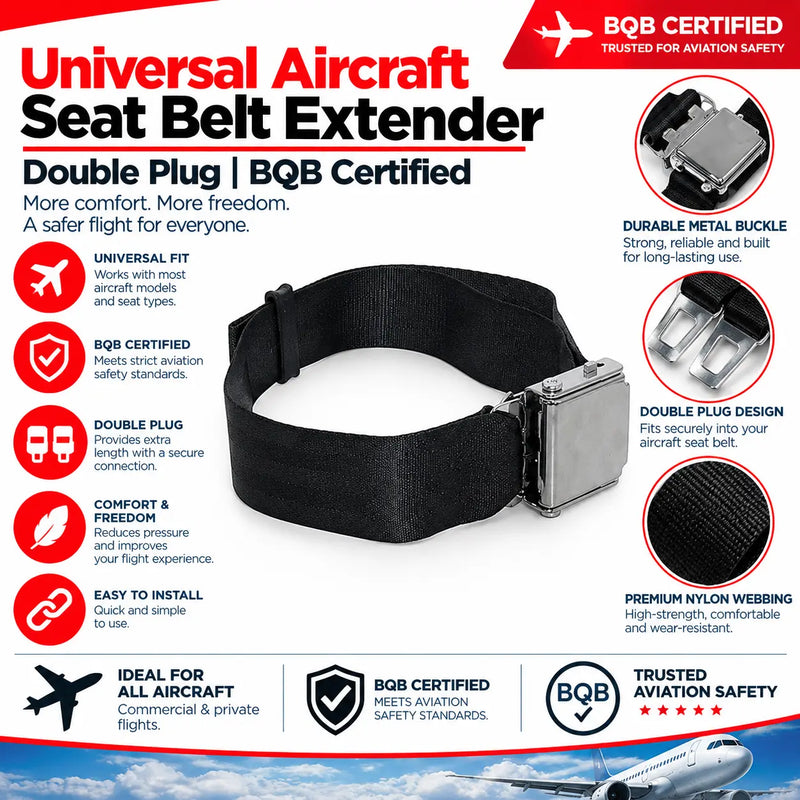
Universal Aircraft Seat Belt Extender - Double Plug, BQB Certified
- Dual-plug connector covers both Type A and Type B airline buckles
- BQB certified, heat-treated lock buckle rated to ~1.6 tons
- Adds 23cm of length, fits most major domestic & international airlines
- ABS nylon webbing + stainless steel hardware, just 210g
- Compact enough for a handbag or carry-on pocket
- Free UK & US delivery, 30-day money-back guarantee
When the Buckle Itself Is the Problem
If the car's own buckle is cracked, loose, or will not latch firmly, no extender fixes that. A faulty belt is also an MOT failure. A matched replacement buckle or receiver, or a full seat belt replacement kit, fitted by a qualified technician, is the correct repair.
How to Test Any Extender Before Relying on It
Expert Tip: Test the extender while seated: the belt should lie flat across the lap and diagonally across the chest, never across the neck or abdomen.
Add a pull test to that. Click the extender in and pull hard on it, then fasten the belt into the extender and pull hard again. Any movement, rattle or partial release means it is wrong for that car. Stop using it.
Airline Travel: Type A, Type B, and Inflatable Seat Belt Warnings
Type A vs Type B Airline Extenders
Type A fits most airlines. Type B is for Southwest and compatible carriers, which matters mainly for domestic US travel rather than flights from the UK.
Expert Tip: If the senior flies, buy a Type A airline extender (or Type B for Southwest) so the same need is covered in the air.
FAA PMA and Airline Policies
FAA PMA tagging shows the part is approved for aircraft use, and cabin crew may ask to see it. Policies vary: some airlines permit only their own extenders, and every airline will provide one on request. Ask at the gate or after boarding rather than discovering the policy mid-flight.
Inflatable Seat Belt Warnings
Some aircraft seats, usually in premium cabins, and some vehicle rear seats are fitted with inflatable seat belts. The belt itself inflates in a crash to spread load across a wider area.
The FAA's advisory circular on child restraints warns that using a seat belt extender with a restraint in a seat equipped with an inflatable seat belt can result in death or serious injury. Vehicle manufacturers that fit inflatable belts give similar warnings.
Expert Tip (corrected): Do not use an extender with an inflatable seat belt unless the vehicle manufacturer or the airline explicitly permits it. An extender can stop an inflatable belt working as designed, and the FAA warns this can cause serious injury or death. Check the owner's manual or ask the cabin crew, and never assume.
How to Use an Extender on a Plane
- Ask a flight attendant before use.
- Attach it only to the aircraft belt, never to anything else.
- Make sure it lies flat across the lap, with no twist.
Combining Car and Air Travel in One Purchase
You cannot. A vehicle extender and an airline extender use different buckles and different approvals. If your parent both drives and flies, plan for two products. Our guide to flying and cabin restraint rules covers the aircraft side in more detail.
Car vs Plane Quick-Reference Card
| Scenario | Extender to buy | Certification to look for |
|---|---|---|
| Daily car use, known vehicle | Rigid vehicle-specific extender | ECE R16 and an E-mark (FMVSS as a secondary signal) |
| Occasional or multi-vehicle car use | Flexible universal extender | ECE R16 and an E-mark |
| Airline travel on most airlines | Type A airplane extender | FAA PMA |
| Southwest or compatible airlines | Type B airplane extender | FAA PMA |
| Only neck or chest pressure | Comfort pad or positioning clip | Not applicable |
When Not to Use an Extender, and Common Mistakes to Avoid
Child Car Seats and Boosters
Expert Tip: Do not use an extender with a child car seat or booster unless the manufacturer and FAA guidance explicitly permit it.
Grandparents carrying grandchildren hit this one often. An extender changes where the belt sits on a small body, which is the one thing a booster exists to control. Our guide on extenders and booster seats explains why the answer is no, and UK child car seat law covers what to use instead.
Wrong Buckle Types
A mismatched extender may not latch, or may release under load. If it does not click cleanly and hold under a firm pull, stop. Do not force it, do not modify it, and do not file anything down.
Damaged or Worn Extenders
Expert Tip: Keep the extender clean and inspect the stitching and buckle regularly; replace it if there is any fraying, cracking, or looseness.
Inflatable Seat Belts
Covered above, and worth repeating: do not use an extender with an inflatable seat belt unless the manufacturer or airline explicitly permits it.
Removing the Extender for Other Occupants
Expert Tip: Remove the extender when a different, smaller occupant uses the seat so the belt geometry stays correct for them.
Common Mistakes to Avoid
- Buying uncertified marketplace extenders.
- Using a universal extender for daily car use when a rigid vehicle-specific one is safer.
- Not testing belt fit while seated.
- Using an extender with a child seat.
- Ignoring airline-specific Type B needs.
- Buying longer than needed, which pushes the lap belt up off the hips.
Comparison Table of Recommended Extenders
| Product | Type | Certification | Best for | Key notes |
|---|---|---|---|---|
| 20cm Rigid Seat Belt Extender | Rigid metal stem | ECE R16 certified | Daily car use; reach and grip problems | Stands upright; check buckle type and tongue width |
| 25cm Rigid Seat Belt Extender | Rigid metal stem | E4 and E8 safety spec | Deeply recessed buckles | More lift; black, grey or beige |
| 23cm Car Seat Belt Extender | Flexible webbing | [CONFIRM AND STATE THE E-MARK FOR THIS SKU] | Belt too short or tight; buckle reachable | Shortest sensible step up; press-release buckle |
| 30 to 80cm Adjustable Extender | Adjustable | [CONFIRM AND STATE] | Shared vehicles, changing users | Re-check the fit after every adjustment |
| Type A Airplane Extender | Universal, aircraft Type A | FAA compliant, PMA-tagged | Air travel on most airlines | Adjustable 18 to 81cm; aircraft use only |
| Type B Plane Extender | Universal, aircraft Type B | FAA compliant | Southwest and compatible airlines | Aircraft use only |
| Comfort pad or positioning clip | Not an extender | Not applicable | Pressure relief only | We do not currently stock these; use when reach is not the issue |
Certification details checked October 2026. Confirm on the product page before purchase.
Alternatives to Extenders: Comfort Pads, Positioning Clips and Reacher Tools
Seat Belt Comfort Pads
Soft padding that wraps around the belt to reduce neck or chest pressure. It does not move the belt, which is exactly why it is safe: the belt path stays as the manufacturer designed it.
Expert Tip: Consider a seat belt comfort pad or repositioning clip first if the only issue is neck or chest pressure rather than reach.
One honest caveat. The Department for Transport advises against improving belt comfort with thick padding or cushions, because bulk can introduce slack. Choose a thin sleeve, check the belt still lies flat and retracts freely, and use the vehicle manufacturer's own comfort accessory if one exists.
Positioning Clips
Clips reposition the shoulder belt away from the neck without adding length. Use only a device that attaches to the shoulder belt alone. Anything that clips the shoulder belt to the lap belt pulls the belt intersection towards the abdomen, which is a different and more serious problem. Our seat belt clips range covers clip-style options, and the article on seat belt adjusters explains the risks in detail.
Reacher Tools
A long-handled grabber that helps pull the belt into place. It solves reach without modifying the belt at all, and costs very little. Often overlooked and sometimes the complete answer.
When a Simpler Solution Is Better
- Can buckle up but feels pressure? A pad or clip is cheaper and avoids certification questions entirely.
- Reach is the only issue? A reacher tool may be enough.
- Both reach and grip are a problem? Then a rigid extender earns its place.
Frequently Asked Questions
Are seat belt extenders safe?
Only when certified and matched to the correct buckle type. For UK cars, look for ECE R16 approval and a genuine E-mark on the part. For aircraft, look for FAA compliance. Uncertified generic extenders are the main risk in the category.
Are seat belt extenders legal?
Generally yes, when certified and used correctly. They do not exempt anyone from wearing a seat belt. Airline policies vary, and some carriers permit only their own extenders.
How do I know which buckle type my car has?
Inspect the latch plate on the belt, note its width in millimetres and the shape of its slot, and compare against the seller's diagrams or a vehicle lookup tool. When unsure, send the seller a photo before buying.
Can I use the same extender in the car and on a plane?
No. Car extenders and airplane extenders use different buckles and different approvals. Buy separate certified products if your parent both drives and flies.
Do I need a Type A or Type B airplane extender?
Type A for most airlines, including the carriers most UK passengers use. Type B for Southwest and compatible airlines, which matters mainly for US domestic flights.
Can I use an extender with a child car seat?
No, unless the car seat manufacturer and vehicle manufacturer explicitly permit it. An extender changes where the belt sits on a small body, which defeats the purpose of a booster.
Will an extender affect airbags or pretensioners?
A correctly matched, certified extender should not interfere. A mismatched or damaged one could. Follow the vehicle manufacturer's guidance, and never use an extender with an inflatable seat belt unless it is explicitly permitted.
How do I clean and maintain an extender?
Wipe it clean, and inspect the stitching, webbing and buckle regularly. Replace it at the first sign of fraying, cracking or looseness.
What if the extender doesn't fit?
Stop using it. Do not force it and do not modify it. Recheck the buckle type and choose a different extender.
Are cheap online extenders safe?
Usually not. Avoid uncertified marketplace units, and buy from a seller who will name the standard, the buckle type and the approval mark.
Before You Buy: Final Safety Checklist
- ☐ Confirm the extender matches the exact vehicle buckle type
- ☐ Check for ECE R16 approval and an E-mark for car use, FAA compliance for air
- ☐ Test while seated: the belt lies flat across the lap and chest, not the neck or abdomen
- ☐ Choose a large release button or rigid handle if grip is an issue
- ☐ Choose the shortest length that works
- ☐ Remove the extender when another occupant uses the seat
- ☐ Verify current specifications and prices before purchase
Work through the checklist with your parent in the car, not from the sofa. Five minutes in the passenger seat tells you more than an hour of reading, ours included.


